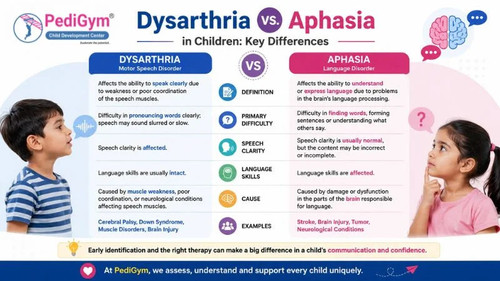
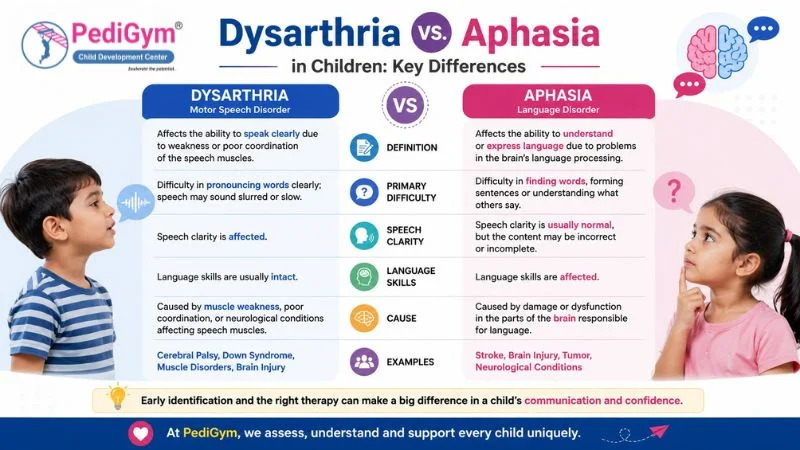
This blog explains the important differences between dysarthria and aphasia in children, two communication disorders that can sometimes appear similar but affect different aspects of communication. Dysarthria primarily affects speech production because weakness or poor coordination of the lips, tongue, jaw, breathing, or other speech muscles can make a child’s speech sound slurred, slow, uneven, weak, or difficult to understand, while aphasia affects the brain’s ability to understand, process, or express language. The article also explains Childhood Apraxia of Speech (CAS), which involves difficulty planning and sequencing speech movements despite normal muscle strength, helping parents understand why these conditions should not be treated as the same problem. It covers common signs and possible causes of dysarthria and aphasia, including neurological conditions, cerebral palsy, traumatic brain injury, pediatric stroke, brain tumors, and other conditions affecting speech or language areas. The blog further discusses how speech-language professionals assess children by looking at speech clarity, oral-motor coordination, language comprehension, vocabulary, sentence formation, developmental history, and communication during everyday activities. It explains that some children can experience dysarthria and aphasia together, making a detailed evaluation particularly important. Treatment is individualized according to the underlying difficulty, with speech therapy for dysarthria focusing on areas such as speech clarity, breath support, oral coordination, voice quality, and communication strategies, while language therapy for aphasia may address vocabulary, sentence formation, comprehension, word retrieval, functional communication, and reading or writing skills when appropriate. The article also highlights the emotional impact communication difficulties can have on children, including frustration, reduced confidence, difficulty participating socially, and avoidance of communication. Parents are given practical ways to support communication at home, such as allowing children enough time to speak, using simple sentences, reducing background noise, encouraging communication through play and books, listening patiently, and praising communication efforts. Most importantly, the blog emphasizes the value of early assessment when speech or language difficulties persist, worsen, affect everyday communication, or involve a sudden loss of previously acquired skills.
Visit Us For More Information:-
https://pedigym.com/dysarthria-vs-aphasia-in-children/
Address: 382, Sector 17, Faridabad, Haryana 121007
Phone: 9873971012
Email: pedigymsector17@gmail.com
Concerned about your child’s speech or language development? Get a professional assessment at PediGym today.
Uploaded 1 month ago